
Showing posts with label police. Show all posts
Showing posts with label police. Show all posts
Monday, 24 August 2015

Friday, 19 July 2013
U.K. Police: six citizens were wrongly detained due to data mining errors last year
Six British citizens were wrongly detained or accused of crimes as a result
of mistakes made by authorities when requesting access to Internet data, the
U.K. Interception of Communications Commissioner said.
A report detailing law enforcement’s errors in the UK was published as interest in surveillance of ordinary citizens’ online activities runs high, in the wake of disclosures about the U.S. National Security Agency’s secret surveillance programs.
In 2012, U.K. public authorities submitted 570,135 notices and authorizations for communications data, according to the report published on Thursday. The principal users of this communications data are still the intelligence agencies, police forces and other law enforcement agencies, wrote Paul Kennedy who served as the Interception of Communications Commissioner through last year.
However, because public authorities often make many requests for communications data in the course of a single investigation, the total figure does not indicate the number of individuals or addresses targeted, Kennedy said, adding that those numbers are not readily available, but would be much smaller.
A report detailing law enforcement’s errors in the UK was published as interest in surveillance of ordinary citizens’ online activities runs high, in the wake of disclosures about the U.S. National Security Agency’s secret surveillance programs.
In 2012, U.K. public authorities submitted 570,135 notices and authorizations for communications data, according to the report published on Thursday. The principal users of this communications data are still the intelligence agencies, police forces and other law enforcement agencies, wrote Paul Kennedy who served as the Interception of Communications Commissioner through last year.
However, because public authorities often make many requests for communications data in the course of a single investigation, the total figure does not indicate the number of individuals or addresses targeted, Kennedy said, adding that those numbers are not readily available, but would be much smaller.
Wednesday, 17 July 2013
UK police use powers to seize personal data at borders

UK police are using counter-terrorism laws to seize the mobile phones of people entering the UK and download their personal data, it has emerged.
This means police can stop anyone at random at UK air, sea and rail ports to seize and retain all the data on their mobiles phones, according to the Telegraph.
This can include call history, contact lists, photos and recent contacts, but not the content of any messages sent by text or email.
The reports say the powers are so broad that police do not even have to show reasonable suspicion for seizing a mobile phone and can retain the information for “as long as is necessary”.
The paper claims that up to 60,000 people a year are examined as they enter or return to the UK under powers contained in the Terrorism Act 2000, but said the number of data seizures is unknown.
The 2013 annual review of terrorism laws, due out this week, is expected to raise concerns over the broad powers granted by the Terrorism Act and call for proper checks and balances to prevent abuse.
Independent legal reviewer David Anderson QC said information downloaded from mobiles seized at ports has been useful in bringing terrorists to justice.
However, he said ordinary travellers need to know that their private information will not be taken without good reason, or retained by the police for any longer than is necessary.
Privacy International has raised concerns about the wide-ranging powers, saying nowhere in the UK do people have fewer rights than at the border.
“If you were on the other side of the border, the police would rightly have to apply for warrants and follow strict guidelines,” the group’s Gus Hosein told the Telegraph.
“Under law, seizing a mobile phone should be only when the phone is essential to an investigation, and even then certain rules should apply. Without these rules, everyone should be worried,” he said.
Privacy watchdog the Information Commissioner’s Office (ICO) is reviewing similar data seizure powers police can use within the UK, although they must have grounds for suspicion and the phone can be seized only if the owner is arrested.
Last year, it emerged that seven UK police forces had installed technology that allowed officers to download data from suspects’ phones, including London’s Metropolitan Police force.
At the time, police authorities said guidelines given to officers state that data extraction can happen only if there is sufficient suspicion that the mobile phone was used for criminal activity.
Friday, 28 June 2013
Police Take Different Approaches To 'The Tyranny Of 911'
Miami Public Service Aide Tatayana Harris enters information into her laptop
after clearing an accident in Miami's Little Havana community. Harris has been a
Miami Police PSA for five years and hopes to become a police officer.
When the 911 phone system was established, it gave citizens a fast, easy way to reach police in an emergency.
But it also created a logistical challenge for law enforcement: Police departments get so many calls, 911 can be as much a burden as a boon. Many calls are non-emergencies, and responding can take police away from situations where they're really needed.
Some call this "the tyranny of 911," says Chuck Wexler, who runs the Police Executive Research Forum, a Washington-based think tank. 911 promises a prompt response to an emergency call, Wexler says, but research has shown that rapid response doesn't make for more arrests or more citizen satisfaction. "But ... there was a tremendous push to get people to call 911, and the system really overloaded," Wexler says.
To deal with the overload, some cities have adopted 311, a non-emergency, easy-to remember number for police assistance and other public services.
Miami Police Department dispatcher Shekita Johnson and officer Ernest Lawrence staff the boards at Miami's Communications Unit. Call-takers in the unit screen the 911 calls, then send them to dispatchers.
Marsha Halper for NPR Miami Police Department dispatcher Shekita Johnson and officer Ernest Lawrence
staff the boards at Miami's Communications Unit. Call-takers in the unit screen
the 911 calls, then send them to dispatchers.
Miami Police Department dispatcher Shekita Johnson and officer Ernest Lawrence
staff the boards at Miami's Communications Unit. Call-takers in the unit screen
the 911 calls, then send them to dispatchers.
Marsha Halper for NPR
Other cities, like Milwaukee, use what they call "differential response": On some calls, you dispatch an officer; on others you take a report by phone.
The City of Miami has devised a different system to help manage the 911 workload. It dispatches what it calls Public Service Aides on non-emergencies, like accidents or crime scenes where the offender is no longer present.
Cars And Uniforms, But No Guns Or Arrests
PSA's drive marked cars, but they have no sirens. They're uniformed, but in light blue shirts — not the dark blue police officers wear. And they're unarmed. Many eventually go on to become police officers.
Miami Chief of Police Manuel Orosa says his force has about 1,100 officers and 50 PSAs. "The PSAs do an extraordinary job," he says, "and they really don't get all the glory they should be getting, because they really hump calls."
Riding with the PSA's is like watching outtakes from the TV show Cops. No danger, no guns, no arrests. Instead, they handle things like fender benders and auto thefts, and fill out lots of reports.
Of course, a fender bender can easily turn from a civil exchange of insurance information to a dangerous encounter, so deciding which calls require a police officer is important.
Today, the Miami Police Department has a 5,000-square-foot communications center, which houses the fire department dispatch center and the city's call-takers. They field thousands of calls daily and pose a set list of questions to the 911 callers. They enter the information in a computer, where it goes to the dispatchers. The dispatchers then send police officers or PSAs to the scene. Each dispatcher could be responsible for 50 police officers on a given day.
More Cellphones Mean More Calls
Harris is upbeat as she responds to a fender bender in Little Havana. PSAs drive marked cars but are unarmed.
Marsha Halper for NPR Harris is upbeat as she responds to a fender bender in Little Havana. PSAs drive
marked cars but are unarmed.
Harris is upbeat as she responds to a fender bender in Little Havana. PSAs drive
marked cars but are unarmed.
Marsha Halper for NPR
"It starts to really, really build up at around 3:30, 4:00 [p.m.], when people start going home and you have wrecks and you have problems," says Amy Diaz, who runs this unit. And things get busy on Thursdays, Fridays and Saturdays, she says. "I mean, like, really, really busy." According to the department's annual report, the system received about 750,000 calls in 2012.
The volume of 911 calls here, and all over the country, isn't just a measure of gross national mayhem; it's also a measure of how Americans use phones. When Diaz started this work 25 years ago, she says, very few people had cellphones. The department would get one, maybe two calls per accident. "Now, to one accident we may end up getting 10, 11, 12 calls," as everyone who comes upon the scene phones in, she says.
Many of the calls aren't about a crime in process but one that has been discovered after the fact. Miami PSA Tatayana Harris works the Flagami and Little Havana neighborhoods. On a recent day, she was called to the home of a 59-year-old, Cuban-born resident who had returned from work to find his wife's car broken into.
The man speaks little English — and Harris speaks little Spanish. Language is a serious issue for PSAs and police officers in Miami, which has many Spanish- and Creole-speakers. If you can't speak Spanish, you often can't conduct interviews. In these cases, the responding officer or aide frequently must call in a bilingual police officer, as Harris does today.
The Future Of 911: Photos And Facebook?
Back at the call center, the six call-takers on duty are all female. Some are bilingual; all have access to an instant interpreting service. And perhaps within the next two years, the Miami 911 call center hopes to begin accepting texts. Eventually, the police also anticipate being able to accept not just texts but also photographs taken with mobile phones.
Of course, those features could mean many more terabytes of data, all in need of triage and review, pouring into 911 call centers. Wexler of PERF foresees those kinds of social media posing a challenge to police.
"You're going to get people who want to text information in, and people who want to use emails to send information in, or Facebook to send information in or Twitter to send information in," he says. "We have so much information coming from so many different directions, you worry about losing something important."
There are potential flaws in all the schemes to neutralize the tyranny of 911. For many people, it's such a memorable number, they still call it even when 311 would be more appropriate.
Skeptics of a differential response system, where some reports are simply taken by phone, say it robs the police of the ability to flush out the significant number of reported auto thefts that are actually insurance scams. And a burglary victim, however removed from danger, still feels a sense of violation that deserves a visit from a cop, detractors say.
But with city budgets tight, some combination of these efforts and a Public Service Aides system like Miami's are likely to figure in the plans of a major police department somewhere near you.
When the 911 phone system was established, it gave citizens a fast, easy way to reach police in an emergency.
But it also created a logistical challenge for law enforcement: Police departments get so many calls, 911 can be as much a burden as a boon. Many calls are non-emergencies, and responding can take police away from situations where they're really needed.
Some call this "the tyranny of 911," says Chuck Wexler, who runs the Police Executive Research Forum, a Washington-based think tank. 911 promises a prompt response to an emergency call, Wexler says, but research has shown that rapid response doesn't make for more arrests or more citizen satisfaction. "But ... there was a tremendous push to get people to call 911, and the system really overloaded," Wexler says.
To deal with the overload, some cities have adopted 311, a non-emergency, easy-to remember number for police assistance and other public services.
Miami Police Department dispatcher Shekita Johnson and officer Ernest Lawrence staff the boards at Miami's Communications Unit. Call-takers in the unit screen the 911 calls, then send them to dispatchers.
Marsha Halper for NPR
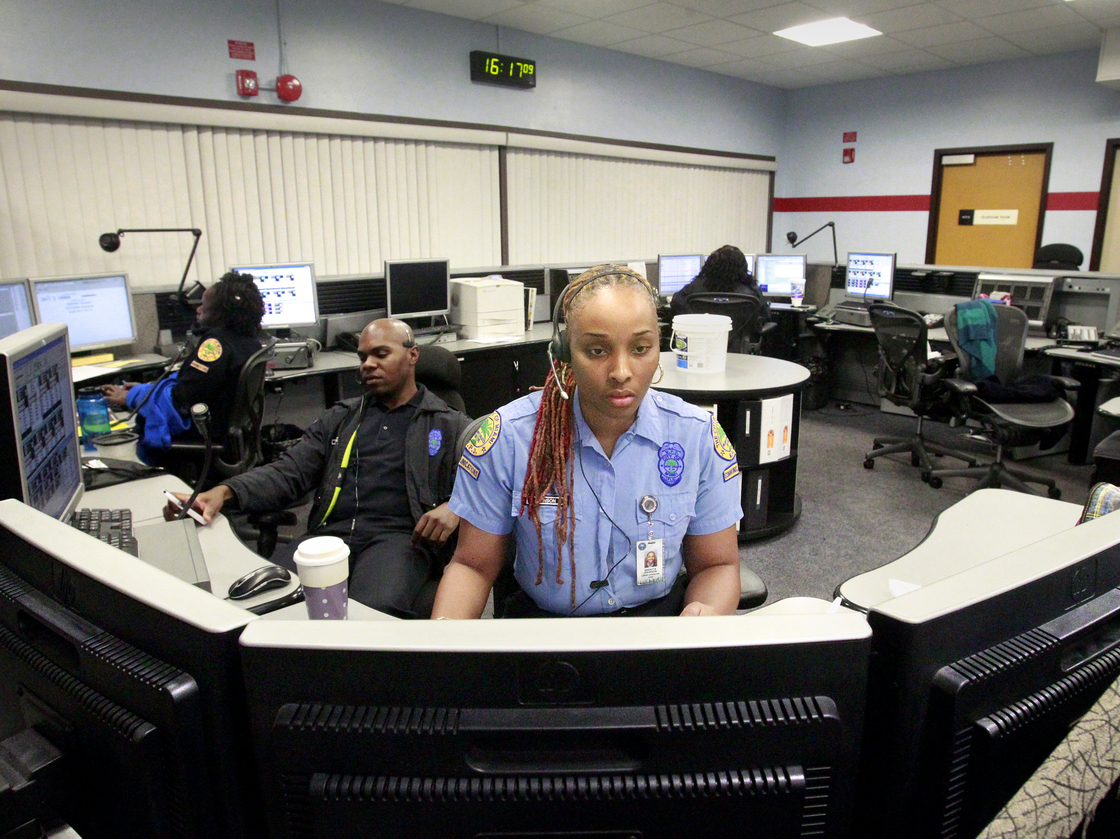 Miami Police Department dispatcher Shekita Johnson and officer Ernest Lawrence
staff the boards at Miami's Communications Unit. Call-takers in the unit screen
the 911 calls, then send them to dispatchers.
Miami Police Department dispatcher Shekita Johnson and officer Ernest Lawrence
staff the boards at Miami's Communications Unit. Call-takers in the unit screen
the 911 calls, then send them to dispatchers.
Marsha Halper for NPR
Other cities, like Milwaukee, use what they call "differential response": On some calls, you dispatch an officer; on others you take a report by phone.
The City of Miami has devised a different system to help manage the 911 workload. It dispatches what it calls Public Service Aides on non-emergencies, like accidents or crime scenes where the offender is no longer present.
Cars And Uniforms, But No Guns Or Arrests
PSA's drive marked cars, but they have no sirens. They're uniformed, but in light blue shirts — not the dark blue police officers wear. And they're unarmed. Many eventually go on to become police officers.
Miami Chief of Police Manuel Orosa says his force has about 1,100 officers and 50 PSAs. "The PSAs do an extraordinary job," he says, "and they really don't get all the glory they should be getting, because they really hump calls."
Riding with the PSA's is like watching outtakes from the TV show Cops. No danger, no guns, no arrests. Instead, they handle things like fender benders and auto thefts, and fill out lots of reports.
Of course, a fender bender can easily turn from a civil exchange of insurance information to a dangerous encounter, so deciding which calls require a police officer is important.
Today, the Miami Police Department has a 5,000-square-foot communications center, which houses the fire department dispatch center and the city's call-takers. They field thousands of calls daily and pose a set list of questions to the 911 callers. They enter the information in a computer, where it goes to the dispatchers. The dispatchers then send police officers or PSAs to the scene. Each dispatcher could be responsible for 50 police officers on a given day.
More Cellphones Mean More Calls
Harris is upbeat as she responds to a fender bender in Little Havana. PSAs drive marked cars but are unarmed.
Marsha Halper for NPR
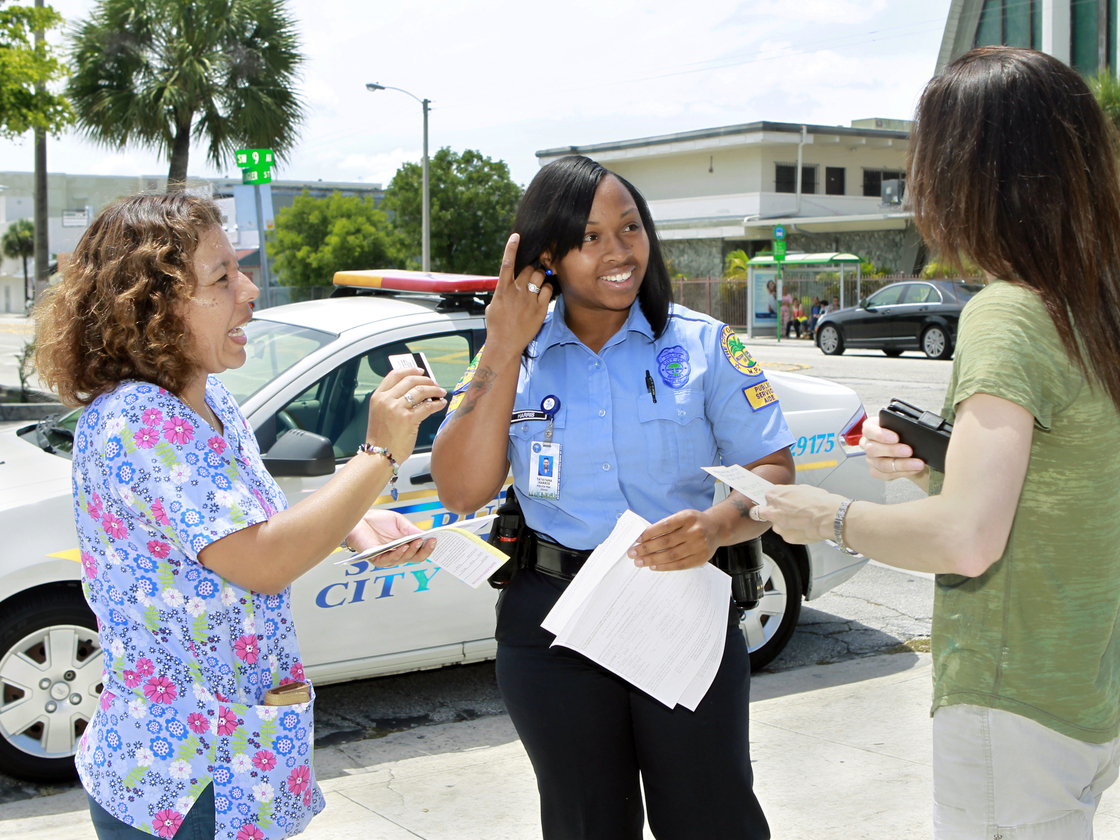 Harris is upbeat as she responds to a fender bender in Little Havana. PSAs drive
marked cars but are unarmed.
Harris is upbeat as she responds to a fender bender in Little Havana. PSAs drive
marked cars but are unarmed.
Marsha Halper for NPR
"It starts to really, really build up at around 3:30, 4:00 [p.m.], when people start going home and you have wrecks and you have problems," says Amy Diaz, who runs this unit. And things get busy on Thursdays, Fridays and Saturdays, she says. "I mean, like, really, really busy." According to the department's annual report, the system received about 750,000 calls in 2012.
The volume of 911 calls here, and all over the country, isn't just a measure of gross national mayhem; it's also a measure of how Americans use phones. When Diaz started this work 25 years ago, she says, very few people had cellphones. The department would get one, maybe two calls per accident. "Now, to one accident we may end up getting 10, 11, 12 calls," as everyone who comes upon the scene phones in, she says.
Many of the calls aren't about a crime in process but one that has been discovered after the fact. Miami PSA Tatayana Harris works the Flagami and Little Havana neighborhoods. On a recent day, she was called to the home of a 59-year-old, Cuban-born resident who had returned from work to find his wife's car broken into.
The man speaks little English — and Harris speaks little Spanish. Language is a serious issue for PSAs and police officers in Miami, which has many Spanish- and Creole-speakers. If you can't speak Spanish, you often can't conduct interviews. In these cases, the responding officer or aide frequently must call in a bilingual police officer, as Harris does today.
The Future Of 911: Photos And Facebook?
Back at the call center, the six call-takers on duty are all female. Some are bilingual; all have access to an instant interpreting service. And perhaps within the next two years, the Miami 911 call center hopes to begin accepting texts. Eventually, the police also anticipate being able to accept not just texts but also photographs taken with mobile phones.
Of course, those features could mean many more terabytes of data, all in need of triage and review, pouring into 911 call centers. Wexler of PERF foresees those kinds of social media posing a challenge to police.
"You're going to get people who want to text information in, and people who want to use emails to send information in, or Facebook to send information in or Twitter to send information in," he says. "We have so much information coming from so many different directions, you worry about losing something important."
There are potential flaws in all the schemes to neutralize the tyranny of 911. For many people, it's such a memorable number, they still call it even when 311 would be more appropriate.
Skeptics of a differential response system, where some reports are simply taken by phone, say it robs the police of the ability to flush out the significant number of reported auto thefts that are actually insurance scams. And a burglary victim, however removed from danger, still feels a sense of violation that deserves a visit from a cop, detractors say.
But with city budgets tight, some combination of these efforts and a Public Service Aides system like Miami's are likely to figure in the plans of a major police department somewhere near you.
Bloomberg's legacy under fire for police tactics in NY City
NEW YORK - A growing chorus of critics has challenged Mayor Michael
Bloomberg's approach to fighting crime, pushing back against policies that he
credits for making New York the safest major city in America.
With a few months left in office, Bloomberg can say crime fell 34 percent over a decade during his tenure. For much of his first two terms, he also was heralded as a healer for the city's tense race relations.
But with Bloomberg's third and final four-year term ending on January 1, Democrats seeking to replace him have joined civil rights leaders and the heavily Democratic city council in hammering at a cornerstone of his legacy: The New York Police Department's crime-fighting tactic known as stop-and-frisk.
Critics say police randomly and unfairly stop young African American and Latino men, most of whom are never charged with crimes after being subjected to searches. But polls show that about half of New Yorkers support stop-and-frisk as a strategy that has helped reduce crime.
This week, the city council defied Bloomberg on the police power issue, approving a pair of measures on Thursday that he vigorously opposed. One creates an independent inspector general to monitor the NYPD, and the other expands the definition of racial profiling and allows people who believe they have been profiled to sue police in state court.
Both measures passed with at least the two-thirds majority needed to override his promised veto.
The defeat was unusual for Bloomberg, 71, a politically independent billionaire who rose to national prominence during more than 11 years in office. Through most of his tenure, Bloomberg has been feared and respected, enhancing his stature with a national coalition Mayors Against Illegal Guns and flirting with a presidential run in 2008.
"For two terms, it didn't percolate so hot, this issue," said Eugene O'Donnell, a professor at John Jay College of Criminal Justice. He said the public's fatigue with Bloomberg and an overall skepticism about police work helped give an opening to some of the more intense critiques of stop-and-frisk.
"It appears there may have been a shift in opinion about policing," O'Donnell said.
A Bloomberg spokesman noted that polling has showed strong public support for Kelly and the NYPD.
PUBLIC OPINION DIVIDED
In heavily Democratic New York City, the winner of the September 10 Democratic primary will be heavily favored against the Republican in the November 5 general election.
All five of the major Democratic candidates have called the number of stop-and-frisk incidents excessive. Only City Council Speaker Christine Quinn, a Bloomberg ally, has said she would keep Police Commissioner Ray Kelly, who has described stop-and-frisk as an invaluable crime-fighting tool, though she said she would demand a drop in the number of stop-and-frisk incidents.
One turning point in the perception about Bloomberg may have come last May, when the New York Civil Liberties Union (NYCLU) released statistics showing police conducted more stops of black males between the ages of 14 and 24 than the total number of young black males living in New York City.
Police stops surged from 160,851 in 2003 to 685,724 in 2011, when 1.8 percent of searches of minority suspects that year resulted in weapons seizures.
At a news conference this week, Bloomberg invoked the high-crime days of the 1970s in a strong warning to council members not to pass the bill.
Bloomberg and Kelly have also irked advocates and members of the city council by invoking the names of al Qaeda and violent street gangs to make their case.
"What they're doing is preying on people's fears. Everyone wants to live in a safer city," said Donna Lieberman, executive director of the NYCLU.
On Friday, Bloomberg appeared to double down.
"And you know, everybody'll say, 'Oh, you're overstating it.' I don't know if you're overstating it or not, but I'm not willing to find out," Bloomberg told a radio program. "I don't know what you'd say at the eulogy if a cop got killed, and say, 'Well it turned out we weren't overstating it. Sorry."
The public's view of the debate is mixed.
A Marist poll released on Thursday found New Yorkers were happy with Kelly - more than half want him to continue in the next administration - and about half said the practice of stop-and-frisk should continue. But just 6 percent of voters thought crime should top the next mayor's agenda.
"It's been some time since crime has been at the top of minds," said Lee Miringoff, director of the Marist Institute for Public Opinion.
A Marist poll from the high-crime days of 1992 found that 33 percent of New Yorkers saw crime as the top issue.
With a few months left in office, Bloomberg can say crime fell 34 percent over a decade during his tenure. For much of his first two terms, he also was heralded as a healer for the city's tense race relations.
But with Bloomberg's third and final four-year term ending on January 1, Democrats seeking to replace him have joined civil rights leaders and the heavily Democratic city council in hammering at a cornerstone of his legacy: The New York Police Department's crime-fighting tactic known as stop-and-frisk.
Critics say police randomly and unfairly stop young African American and Latino men, most of whom are never charged with crimes after being subjected to searches. But polls show that about half of New Yorkers support stop-and-frisk as a strategy that has helped reduce crime.
This week, the city council defied Bloomberg on the police power issue, approving a pair of measures on Thursday that he vigorously opposed. One creates an independent inspector general to monitor the NYPD, and the other expands the definition of racial profiling and allows people who believe they have been profiled to sue police in state court.
Both measures passed with at least the two-thirds majority needed to override his promised veto.
The defeat was unusual for Bloomberg, 71, a politically independent billionaire who rose to national prominence during more than 11 years in office. Through most of his tenure, Bloomberg has been feared and respected, enhancing his stature with a national coalition Mayors Against Illegal Guns and flirting with a presidential run in 2008.
"For two terms, it didn't percolate so hot, this issue," said Eugene O'Donnell, a professor at John Jay College of Criminal Justice. He said the public's fatigue with Bloomberg and an overall skepticism about police work helped give an opening to some of the more intense critiques of stop-and-frisk.
"It appears there may have been a shift in opinion about policing," O'Donnell said.
A Bloomberg spokesman noted that polling has showed strong public support for Kelly and the NYPD.
PUBLIC OPINION DIVIDED
In heavily Democratic New York City, the winner of the September 10 Democratic primary will be heavily favored against the Republican in the November 5 general election.
All five of the major Democratic candidates have called the number of stop-and-frisk incidents excessive. Only City Council Speaker Christine Quinn, a Bloomberg ally, has said she would keep Police Commissioner Ray Kelly, who has described stop-and-frisk as an invaluable crime-fighting tool, though she said she would demand a drop in the number of stop-and-frisk incidents.
One turning point in the perception about Bloomberg may have come last May, when the New York Civil Liberties Union (NYCLU) released statistics showing police conducted more stops of black males between the ages of 14 and 24 than the total number of young black males living in New York City.
Police stops surged from 160,851 in 2003 to 685,724 in 2011, when 1.8 percent of searches of minority suspects that year resulted in weapons seizures.
At a news conference this week, Bloomberg invoked the high-crime days of the 1970s in a strong warning to council members not to pass the bill.
Bloomberg and Kelly have also irked advocates and members of the city council by invoking the names of al Qaeda and violent street gangs to make their case.
"What they're doing is preying on people's fears. Everyone wants to live in a safer city," said Donna Lieberman, executive director of the NYCLU.
On Friday, Bloomberg appeared to double down.
"And you know, everybody'll say, 'Oh, you're overstating it.' I don't know if you're overstating it or not, but I'm not willing to find out," Bloomberg told a radio program. "I don't know what you'd say at the eulogy if a cop got killed, and say, 'Well it turned out we weren't overstating it. Sorry."
The public's view of the debate is mixed.
A Marist poll released on Thursday found New Yorkers were happy with Kelly - more than half want him to continue in the next administration - and about half said the practice of stop-and-frisk should continue. But just 6 percent of voters thought crime should top the next mayor's agenda.
"It's been some time since crime has been at the top of minds," said Lee Miringoff, director of the Marist Institute for Public Opinion.
A Marist poll from the high-crime days of 1992 found that 33 percent of New Yorkers saw crime as the top issue.
Thursday, 27 June 2013
Write a Fashion Police Caption for Sarah Jessica Parker
 Sarah Jessica Parker attends the opening night for 'Charlie And The Chocolate Factory' at Theatre Royal on June 25, 2013 in London, England. Credit: Fred Duval/FilmMagic
Think you have what it takes to be an Us Top Cop?
PHOTOS: Hollywood's biggest style offenders
Write a snippy one-liner for this photo of Sarah Jessica Parker. If you want your joke to appear in a copy of Us Weekly, please leave your full name in your comment.
Subscribe to:
Posts (Atom)