
Miami Public Service Aide Tatayana Harris enters information into her laptop
after clearing an accident in Miami's Little Havana community. Harris has been a
Miami Police PSA for five years and hopes to become a police officer.
When the 911 phone system was established, it gave citizens a fast, easy way to reach police in an emergency.
But it also created a logistical challenge for law enforcement: Police departments get so many calls, 911 can be as much a burden as a boon. Many calls are non-emergencies, and responding can take police away from situations where they're really needed.
Some call this "the tyranny of 911," says Chuck Wexler, who runs the Police Executive Research Forum, a Washington-based think tank. 911 promises a prompt response to an emergency call, Wexler says, but research has shown that rapid response doesn't make for more arrests or more citizen satisfaction. "But ... there was a tremendous push to get people to call 911, and the system really overloaded," Wexler says.
To deal with the overload, some cities have adopted 311, a non-emergency, easy-to remember number for police assistance and other public services.
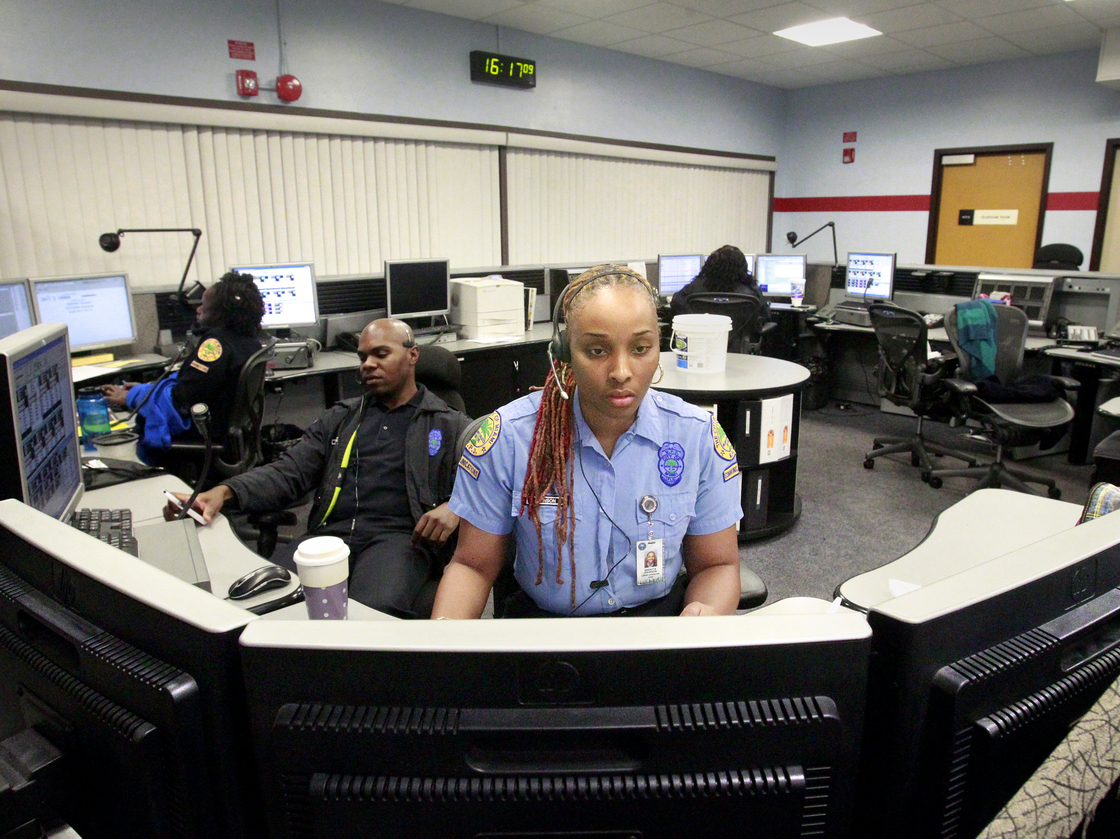
Miami Police Department dispatcher Shekita Johnson and officer Ernest Lawrence staff the boards at Miami's Communications Unit. Call-takers in the unit screen the 911 calls, then send them to dispatchers.
Marsha Halper for NPR Miami Police Department dispatcher Shekita Johnson and officer Ernest Lawrence
staff the boards at Miami's Communications Unit. Call-takers in the unit screen
the 911 calls, then send them to dispatchers.
Miami Police Department dispatcher Shekita Johnson and officer Ernest Lawrence
staff the boards at Miami's Communications Unit. Call-takers in the unit screen
the 911 calls, then send them to dispatchers.
Marsha Halper for NPR
Other cities, like Milwaukee, use what they call "differential response": On some calls, you dispatch an officer; on others you take a report by phone.
The City of Miami has devised a different system to help manage the 911 workload. It dispatches what it calls Public Service Aides on non-emergencies, like accidents or crime scenes where the offender is no longer present.
Cars And Uniforms, But No Guns Or Arrests
PSA's drive marked cars, but they have no sirens. They're uniformed, but in light blue shirts — not the dark blue police officers wear. And they're unarmed. Many eventually go on to become police officers.
Miami Chief of Police Manuel Orosa says his force has about 1,100 officers and 50 PSAs. "The PSAs do an extraordinary job," he says, "and they really don't get all the glory they should be getting, because they really hump calls."
Riding with the PSA's is like watching outtakes from the TV show Cops. No danger, no guns, no arrests. Instead, they handle things like fender benders and auto thefts, and fill out lots of reports.
Of course, a fender bender can easily turn from a civil exchange of insurance information to a dangerous encounter, so deciding which calls require a police officer is important.
Today, the Miami Police Department has a 5,000-square-foot communications center, which houses the fire department dispatch center and the city's call-takers. They field thousands of calls daily and pose a set list of questions to the 911 callers. They enter the information in a computer, where it goes to the dispatchers. The dispatchers then send police officers or PSAs to the scene. Each dispatcher could be responsible for 50 police officers on a given day.
More Cellphones Mean More Calls
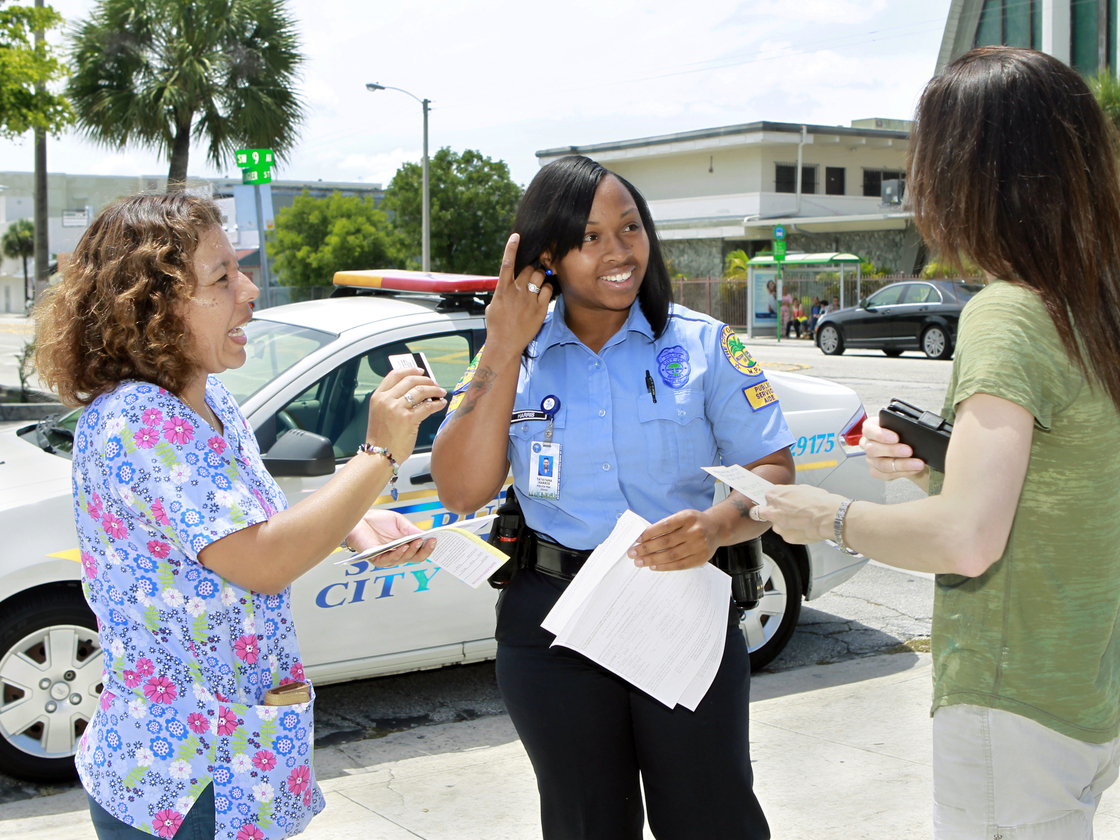
Harris is upbeat as she responds to a fender bender in Little Havana. PSAs drive marked cars but are unarmed.
Marsha Halper for NPR Harris is upbeat as she responds to a fender bender in Little Havana. PSAs drive
marked cars but are unarmed.
Harris is upbeat as she responds to a fender bender in Little Havana. PSAs drive
marked cars but are unarmed.
Marsha Halper for NPR
"It starts to really, really build up at around 3:30, 4:00 [p.m.], when people start going home and you have wrecks and you have problems," says Amy Diaz, who runs this unit. And things get busy on Thursdays, Fridays and Saturdays, she says. "I mean, like, really, really busy." According to the department's annual report, the system received about 750,000 calls in 2012.
The volume of 911 calls here, and all over the country, isn't just a measure of gross national mayhem; it's also a measure of how Americans use phones. When Diaz started this work 25 years ago, she says, very few people had cellphones. The department would get one, maybe two calls per accident. "Now, to one accident we may end up getting 10, 11, 12 calls," as everyone who comes upon the scene phones in, she says.
Many of the calls aren't about a crime in process but one that has been discovered after the fact. Miami PSA Tatayana Harris works the Flagami and Little Havana neighborhoods. On a recent day, she was called to the home of a 59-year-old, Cuban-born resident who had returned from work to find his wife's car broken into.
The man speaks little English — and Harris speaks little Spanish. Language is a serious issue for PSAs and police officers in Miami, which has many Spanish- and Creole-speakers. If you can't speak Spanish, you often can't conduct interviews. In these cases, the responding officer or aide frequently must call in a bilingual police officer, as Harris does today.
The Future Of 911: Photos And Facebook?
Back at the call center, the six call-takers on duty are all female. Some are bilingual; all have access to an instant interpreting service. And perhaps within the next two years, the Miami 911 call center hopes to begin accepting texts. Eventually, the police also anticipate being able to accept not just texts but also photographs taken with mobile phones.
Of course, those features could mean many more terabytes of data, all in need of triage and review, pouring into 911 call centers. Wexler of PERF foresees those kinds of social media posing a challenge to police.
"You're going to get people who want to text information in, and people who want to use emails to send information in, or Facebook to send information in or Twitter to send information in," he says. "We have so much information coming from so many different directions, you worry about losing something important."
There are potential flaws in all the schemes to neutralize the tyranny of 911. For many people, it's such a memorable number, they still call it even when 311 would be more appropriate.
Skeptics of a differential response system, where some reports are simply taken by phone, say it robs the police of the ability to flush out the significant number of reported auto thefts that are actually insurance scams. And a burglary victim, however removed from danger, still feels a sense of violation that deserves a visit from a cop, detractors say.
But with city budgets tight, some combination of these efforts and a Public Service Aides system like Miami's are likely to figure in the plans of a major police department somewhere near you.
When the 911 phone system was established, it gave citizens a fast, easy way to reach police in an emergency.
But it also created a logistical challenge for law enforcement: Police departments get so many calls, 911 can be as much a burden as a boon. Many calls are non-emergencies, and responding can take police away from situations where they're really needed.
Some call this "the tyranny of 911," says Chuck Wexler, who runs the Police Executive Research Forum, a Washington-based think tank. 911 promises a prompt response to an emergency call, Wexler says, but research has shown that rapid response doesn't make for more arrests or more citizen satisfaction. "But ... there was a tremendous push to get people to call 911, and the system really overloaded," Wexler says.
To deal with the overload, some cities have adopted 311, a non-emergency, easy-to remember number for police assistance and other public services.
Miami Police Department dispatcher Shekita Johnson and officer Ernest Lawrence staff the boards at Miami's Communications Unit. Call-takers in the unit screen the 911 calls, then send them to dispatchers.
Marsha Halper for NPR
 Miami Police Department dispatcher Shekita Johnson and officer Ernest Lawrence
staff the boards at Miami's Communications Unit. Call-takers in the unit screen
the 911 calls, then send them to dispatchers.
Miami Police Department dispatcher Shekita Johnson and officer Ernest Lawrence
staff the boards at Miami's Communications Unit. Call-takers in the unit screen
the 911 calls, then send them to dispatchers.
Marsha Halper for NPR
Other cities, like Milwaukee, use what they call "differential response": On some calls, you dispatch an officer; on others you take a report by phone.
The City of Miami has devised a different system to help manage the 911 workload. It dispatches what it calls Public Service Aides on non-emergencies, like accidents or crime scenes where the offender is no longer present.
Cars And Uniforms, But No Guns Or Arrests
PSA's drive marked cars, but they have no sirens. They're uniformed, but in light blue shirts — not the dark blue police officers wear. And they're unarmed. Many eventually go on to become police officers.
Miami Chief of Police Manuel Orosa says his force has about 1,100 officers and 50 PSAs. "The PSAs do an extraordinary job," he says, "and they really don't get all the glory they should be getting, because they really hump calls."
Riding with the PSA's is like watching outtakes from the TV show Cops. No danger, no guns, no arrests. Instead, they handle things like fender benders and auto thefts, and fill out lots of reports.
Of course, a fender bender can easily turn from a civil exchange of insurance information to a dangerous encounter, so deciding which calls require a police officer is important.
Today, the Miami Police Department has a 5,000-square-foot communications center, which houses the fire department dispatch center and the city's call-takers. They field thousands of calls daily and pose a set list of questions to the 911 callers. They enter the information in a computer, where it goes to the dispatchers. The dispatchers then send police officers or PSAs to the scene. Each dispatcher could be responsible for 50 police officers on a given day.
More Cellphones Mean More Calls
Harris is upbeat as she responds to a fender bender in Little Havana. PSAs drive marked cars but are unarmed.
Marsha Halper for NPR
 Harris is upbeat as she responds to a fender bender in Little Havana. PSAs drive
marked cars but are unarmed.
Harris is upbeat as she responds to a fender bender in Little Havana. PSAs drive
marked cars but are unarmed.
Marsha Halper for NPR
"It starts to really, really build up at around 3:30, 4:00 [p.m.], when people start going home and you have wrecks and you have problems," says Amy Diaz, who runs this unit. And things get busy on Thursdays, Fridays and Saturdays, she says. "I mean, like, really, really busy." According to the department's annual report, the system received about 750,000 calls in 2012.
The volume of 911 calls here, and all over the country, isn't just a measure of gross national mayhem; it's also a measure of how Americans use phones. When Diaz started this work 25 years ago, she says, very few people had cellphones. The department would get one, maybe two calls per accident. "Now, to one accident we may end up getting 10, 11, 12 calls," as everyone who comes upon the scene phones in, she says.
Many of the calls aren't about a crime in process but one that has been discovered after the fact. Miami PSA Tatayana Harris works the Flagami and Little Havana neighborhoods. On a recent day, she was called to the home of a 59-year-old, Cuban-born resident who had returned from work to find his wife's car broken into.
The man speaks little English — and Harris speaks little Spanish. Language is a serious issue for PSAs and police officers in Miami, which has many Spanish- and Creole-speakers. If you can't speak Spanish, you often can't conduct interviews. In these cases, the responding officer or aide frequently must call in a bilingual police officer, as Harris does today.
The Future Of 911: Photos And Facebook?
Back at the call center, the six call-takers on duty are all female. Some are bilingual; all have access to an instant interpreting service. And perhaps within the next two years, the Miami 911 call center hopes to begin accepting texts. Eventually, the police also anticipate being able to accept not just texts but also photographs taken with mobile phones.
Of course, those features could mean many more terabytes of data, all in need of triage and review, pouring into 911 call centers. Wexler of PERF foresees those kinds of social media posing a challenge to police.
"You're going to get people who want to text information in, and people who want to use emails to send information in, or Facebook to send information in or Twitter to send information in," he says. "We have so much information coming from so many different directions, you worry about losing something important."
There are potential flaws in all the schemes to neutralize the tyranny of 911. For many people, it's such a memorable number, they still call it even when 311 would be more appropriate.
Skeptics of a differential response system, where some reports are simply taken by phone, say it robs the police of the ability to flush out the significant number of reported auto thefts that are actually insurance scams. And a burglary victim, however removed from danger, still feels a sense of violation that deserves a visit from a cop, detractors say.
But with city budgets tight, some combination of these efforts and a Public Service Aides system like Miami's are likely to figure in the plans of a major police department somewhere near you.
