
The gap between the buildings is where the Rana Plaza stood until a few
months ago. More than 1,000 people were killed when the building collapsed April
24. It was the worst disaster in the garment industry's history.
It's been 2 1/2 months since the Rana Plaza collapsed on garment workers in Bangladesh, exposing abysmal safety conditions in the country's factories.
On a recent trip to Bangladesh, I sought out the survivors of what was the deadliest disaster in the history of the garment industry. An overwhelming number are women many in their early 20s.
A visit to one of the hospitals provided a glimpse into the sort of injuries they sustained while sandwiched between floors as Rana Plaza buckled: giant metal screws protrude from arms and legs literally holding limbs together.
Rebecca Khatun, a worker at Rana Plaza, lies in a hospital bed. She lost her left leg and right foot in the collapse, which also killed five members of her family. Khatun received $120 and free medical care for her loss â?? compensation she says won't be enough for what she's been through.
Rebecca Khatun wasn't so lucky. The petite 22-year-old, her raven-hair plaited in a thick braid, is splayed across a hospital bed in a ward lined with rows of victims. Mosquito netting covers her amputated leg. A stump bandaged just below her hip is all that remains. Cockroaches swarm the railing of her metal bed, just one more indignity in the calamity that has claimed five members of her family.
"My mother, grandmother and two cousins were all working inside the factory that day. But there is no trace of them. How can that be," she asks incredulously.
Only the body parts of a fifth relative were found.
"I lost my left leg and right foot," she says, gently weeping. "But it's even more painful that my mother is lost from my life."
The mother-daughter team worked side-by-side at the Ether Tex garment factory operating on the fifth floor. Her mother came to her and said, "let's have breakfast and then start working." Khatun was already sewing and told her, "You go and I'll catch up." It was the last time they spoke.
On the morning of the collapse, Khatun says, "We didn't want to enter the building because of the huge cracks" detected the day before. "But the manager told us unless you go in, you won't get paid and you'll lose your job. So, we entered, but I vowed then that I would collect that month's salary and quit."
She lay crushed beneath a beam all day and all night until rescuers discovered her the next day.
Khatun received $120 in compensation and free medical care. She's awaiting an additional 1 million taka — or $12,000 — that the government promised for the grievously injured. It's a considerable amount in one of the poorest countries in Asia, but Khatun's doleful eyes flash with anger as she considers the sum.
"Seven members of my family worked there. Just two of us are alive. I've lost my limbs," she says. "How can $12,000 ever be enough?"
In a bed nearby, 23-year-old Rojina Akter's right leg weeps with wounds. She recalls on the morning of the disaster that the power failed.
"As soon as the power generators switched on, the building collapsed," Akter says.
It's believed that vibrations from the huge rooftop generators contributed to the chain of events.
Rojina Akter was also hurt in the collapse. The 23-year-old earned $65 a month as a sewer's assistant. "We are poor," she says. "We work to live." She says the government should have overseen the construction of the building.
Julie McCarthy/NPR Rojina Akter was also hurt in the collapse.
The 23-year-old earned $65 a month as a sewer's assistant. "We are poor," she
says. "We work to live." She says the government should have overseen the
construction of the building.
Akter says she was one of 16 workers who were trapped in a tiny space as beams began falling all around them. A male colleague found a hole in the rubble, and "we made a rope tying their scarves together ... I was numb with pain, but I cried out with joy after seeing the sky. I thanked Allah. I was so thankful to be alive."
Akter earned $65 a month as a sewer's assistant; the minimum wage for Bangladesh's garment workers is $37 a month.
"We are poor. We work to live," she says. "We entered the factory because we needed to be paid. But the government should have overseen the construction of Rana Plaza: It was built on marshy land."
And, she says, the top three floors were added illegally.
The titans of the garment industry like to brag that the factories have liberated women in the conservative culture of Bangladesh by getting them out of the house to earn money.
Workers' rights activists look to Western retailers and consumers to use their economic leverage to press for greater wages and safer working conditions for Bangladesh's 4 million garment workers. Some 70 retailers, mostly European, signed an agreement this week to conduct independent inspections of factories and to finance fire and safety upgrades.
U.S. retailers such as Gap and Walmart refused to sign on. Walmart corporate affairs told NPR in an email that the company will unveil its own "broader safety plan with an alliance of brands and retailers" and that Walmart "is paying for in-depth safety audits" at "every factory directly producing products" for it. But Walmart would not say whether the audits were independent or whether the plan is binding.
Khatun, who lost her leg and members of her family, says if there had been a union at Rana Plaza "this accident would not have happened because we would have had a stronger voice" to bargain with the managers and the factory owners.
Only a tiny fraction of the country's 5,000 garment factories have unions.
Akter is more skeptical about unions, and says frequently the union leaders are co-opted by the owners who single them out for a raise so "they cease their protests." Nor does she think that raising the cost of clothes for Western consumers will help the workers.
"Even if the consumers pay double," she says "the factory owners will not pass along that increase to us."
As Akter talks, her mother dabs medicine on her daughter's wounded leg. The 23-year-old is not only traumatized physically but mentally, as well. She suffers nightmares that the hospital is caving in. But the disaster has not diminished her dreams.
"I'm planning to buy a plot of land to farm with the money I received from generous donors," she says. "One man gave me a sewing machine and told me, 'Get well and don't ever go back to a factory.'
"I won't," she says.
But Akter is anxious to get back home to her simple corrugated tin shed where, at least, she says, "it's safe."
It's been 2 1/2 months since the Rana Plaza collapsed on garment workers in Bangladesh, exposing abysmal safety conditions in the country's factories.
On a recent trip to Bangladesh, I sought out the survivors of what was the deadliest disaster in the history of the garment industry. An overwhelming number are women many in their early 20s.
A visit to one of the hospitals provided a glimpse into the sort of injuries they sustained while sandwiched between floors as Rana Plaza buckled: giant metal screws protrude from arms and legs literally holding limbs together.
Rebecca Khatun, a worker at Rana Plaza, lies in a hospital bed. She lost her left leg and right foot in the collapse, which also killed five members of her family. Khatun received $120 and free medical care for her loss â?? compensation she says won't be enough for what she's been through.
Rebecca Khatun wasn't so lucky. The petite 22-year-old, her raven-hair plaited in a thick braid, is splayed across a hospital bed in a ward lined with rows of victims. Mosquito netting covers her amputated leg. A stump bandaged just below her hip is all that remains. Cockroaches swarm the railing of her metal bed, just one more indignity in the calamity that has claimed five members of her family.
"My mother, grandmother and two cousins were all working inside the factory that day. But there is no trace of them. How can that be," she asks incredulously.
Only the body parts of a fifth relative were found.
"I lost my left leg and right foot," she says, gently weeping. "But it's even more painful that my mother is lost from my life."
The mother-daughter team worked side-by-side at the Ether Tex garment factory operating on the fifth floor. Her mother came to her and said, "let's have breakfast and then start working." Khatun was already sewing and told her, "You go and I'll catch up." It was the last time they spoke.
On the morning of the collapse, Khatun says, "We didn't want to enter the building because of the huge cracks" detected the day before. "But the manager told us unless you go in, you won't get paid and you'll lose your job. So, we entered, but I vowed then that I would collect that month's salary and quit."
She lay crushed beneath a beam all day and all night until rescuers discovered her the next day.
Khatun received $120 in compensation and free medical care. She's awaiting an additional 1 million taka — or $12,000 — that the government promised for the grievously injured. It's a considerable amount in one of the poorest countries in Asia, but Khatun's doleful eyes flash with anger as she considers the sum.
"Seven members of my family worked there. Just two of us are alive. I've lost my limbs," she says. "How can $12,000 ever be enough?"
In a bed nearby, 23-year-old Rojina Akter's right leg weeps with wounds. She recalls on the morning of the disaster that the power failed.
"As soon as the power generators switched on, the building collapsed," Akter says.
It's believed that vibrations from the huge rooftop generators contributed to the chain of events.
Rojina Akter was also hurt in the collapse. The 23-year-old earned $65 a month as a sewer's assistant. "We are poor," she says. "We work to live." She says the government should have overseen the construction of the building.
Julie McCarthy/NPR
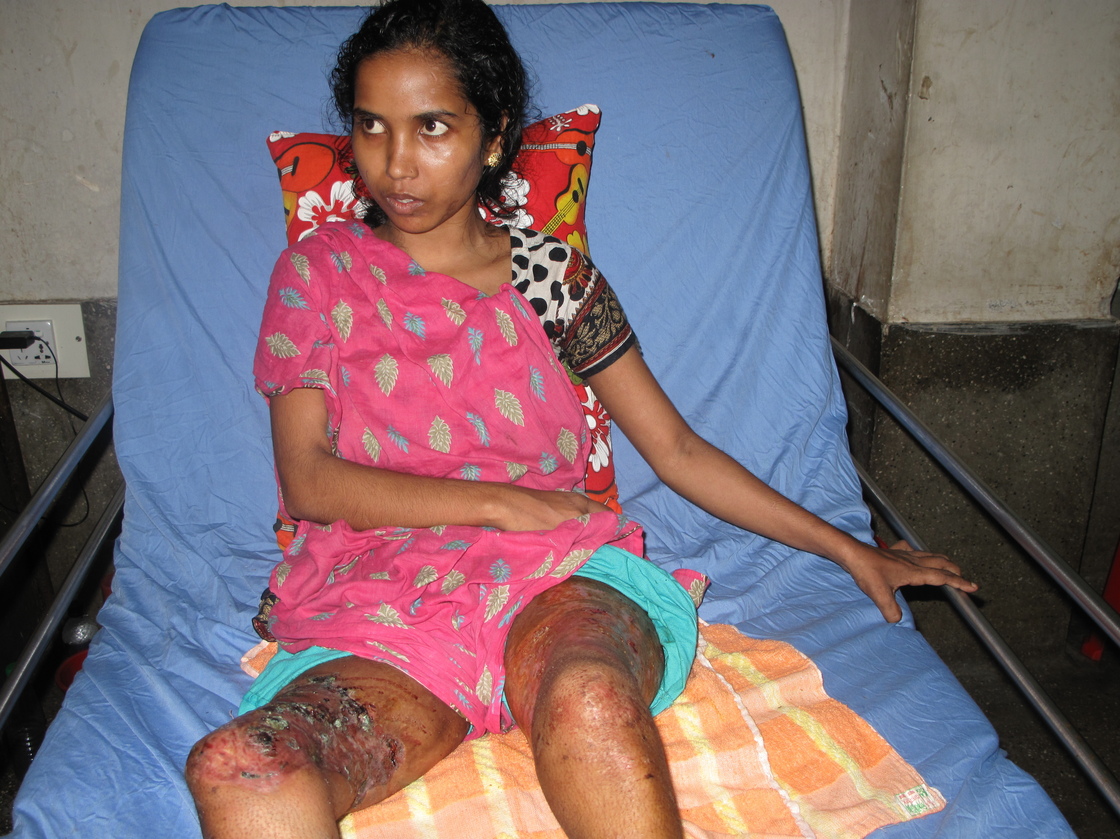 Rojina Akter was also hurt in the collapse.
The 23-year-old earned $65 a month as a sewer's assistant. "We are poor," she
says. "We work to live." She says the government should have overseen the
construction of the building.
Akter says she was one of 16 workers who were trapped in a tiny space as beams began falling all around them. A male colleague found a hole in the rubble, and "we made a rope tying their scarves together ... I was numb with pain, but I cried out with joy after seeing the sky. I thanked Allah. I was so thankful to be alive."
Akter earned $65 a month as a sewer's assistant; the minimum wage for Bangladesh's garment workers is $37 a month.
"We are poor. We work to live," she says. "We entered the factory because we needed to be paid. But the government should have overseen the construction of Rana Plaza: It was built on marshy land."
And, she says, the top three floors were added illegally.
The titans of the garment industry like to brag that the factories have liberated women in the conservative culture of Bangladesh by getting them out of the house to earn money.
Workers' rights activists look to Western retailers and consumers to use their economic leverage to press for greater wages and safer working conditions for Bangladesh's 4 million garment workers. Some 70 retailers, mostly European, signed an agreement this week to conduct independent inspections of factories and to finance fire and safety upgrades.
U.S. retailers such as Gap and Walmart refused to sign on. Walmart corporate affairs told NPR in an email that the company will unveil its own "broader safety plan with an alliance of brands and retailers" and that Walmart "is paying for in-depth safety audits" at "every factory directly producing products" for it. But Walmart would not say whether the audits were independent or whether the plan is binding.
Khatun, who lost her leg and members of her family, says if there had been a union at Rana Plaza "this accident would not have happened because we would have had a stronger voice" to bargain with the managers and the factory owners.
Only a tiny fraction of the country's 5,000 garment factories have unions.
Akter is more skeptical about unions, and says frequently the union leaders are co-opted by the owners who single them out for a raise so "they cease their protests." Nor does she think that raising the cost of clothes for Western consumers will help the workers.
"Even if the consumers pay double," she says "the factory owners will not pass along that increase to us."
As Akter talks, her mother dabs medicine on her daughter's wounded leg. The 23-year-old is not only traumatized physically but mentally, as well. She suffers nightmares that the hospital is caving in. But the disaster has not diminished her dreams.
"I'm planning to buy a plot of land to farm with the money I received from generous donors," she says. "One man gave me a sewing machine and told me, 'Get well and don't ever go back to a factory.'
"I won't," she says.
But Akter is anxious to get back home to her simple corrugated tin shed where, at least, she says, "it's safe."
