Showing posts with label Martin. Show all posts

Tuesday, 27 August 2013

Interview: Martin Russell, head of IT services, Just Eat


Martin Russell, head of IT services at Just Eat, is test driving a £1,000 Google ChromeBook Pixel and tells Computer Weekly about his experiences of going Google.

Just Eat launched in 2001 and now operates in 13 countries around the globe with nearly 1,000 employees.

After experiencing internal email issues and difficulties migrating systems following acquisitions, the company moved to Google Apps for Business in February 2012.

Martin Russell joined Just Eat two and a half years ago. At the time the online takeaway food service had a Microsoft Exchange on-premise server and faced the problems of a  business running its own on-premise Exchange Server normally experience. He says: "We had a massive failure and I spent seven days recovering data."

So why not use a co-location service to run the Just Eat Exchange server in a hosted data centre? "A co-lo facility only solves power and cooling. We would still have to manage the server ourselves." The clincher for Russell was that Just Eat is in the business of takeaway food. “Running on-premise was taking up a lot of man hours to maintain the email service.”

So he decided to look at the cloud. The choices were Google Apps and Office 365. He admits his only experience of Gmail was as a consumer. "I used Gmail at home, but I hadn't considered Google in the corporate world." Nevertheless he decided to work with Google consultant AppsCare to see ho wGmail could be used in the enterprise. "At only £33 per user per year, we were very impressed with Gmail, compared to Microsoft," he adds.

Switching to the cloud is the easy part – getting people to change the software they are accustomed to can be a bigger challenge.

Russell did not give the staff any choice over whether to opt out of Google. "We didn’t tell people we were moving off Microsoft Office and we tend to challenge any requirement for Microsoft Office." When people ask for Microsoft Word he explains to them how Google Docs can resave Word files. "If you have complex spreadsheets then you can have Microsoft Excel. But for general use, we tend to challenge any requirement for Office."

Training involved showing staff Google Apps, Google Drive and the collaboration tools. This is backed up with a weekly “Google Tip of the Week” newsletter. Rather than spending a lot of time writing up a  text-based guide, Russell’s team sends out a quick video tip instead which, he says, has been a big success. "We sometimes get email from people saying I didn’t get my Google tip email."

I like the idea of users being the first line of support

Martin Russell, Just Eat

Everyone in the support team has a chance to shoot a video tip, he says.

Russell also believes in self-help. "I like the idea of users being the first line of support." For instance, in a home environment, the iPad is intuitive, so people are able to figure out how to use it themselves. "You don’t call first line support to ask what to do. Why can’t we make our corporate tools as intuitive as Apple’s, so you can use them without tech support?"

For Russell, cloud computing and pay-per-use services are the way forward. He says: "Whenever we look at a solution we and have to worry about disaster recovery and power issues. But all the business wants is the ability to take customer calls."

Just Eat operates on a postcode-by-postcode basis and is available in 13 countries with local contacts for the callcentre who have knowledge of the local takeaways. Just Eat runs its callcentres using an on-premise telephony system. But as the business grows, the system needs to be upgraded. "When I started here we had 200 people. This has now expanded to 1,000."

Russell would like to see a callcentre telephony service priced on a per-user, per-month basis. This would be easier to scale compared to its existing on-premise system.

Russell believes companies offering telephony software should be looking to develop cloud-based services.

All Just Eat most applications are built internally. The biggest barrier to moving everything to the cloud for Russell is telephony, since it requires a desktop installation for the call manager. "We use Cisco for IP telephony," he adds, "but browser-based cloud based telephony would offer considerable savings."

Russell’s vision for a next-generation callcentre would be based on Chromebooks. A thin-client architecture makes sense in the callcentre, due to the focused nature of call handling. "We used to run thin clients using a massive server farm."

The ChromeBox, a Google desktop ChromeOS device, does away with the server farm as it connects directly to web applications. "The ChromeBox gives thin client without the server farm. I can deploy a callcentre application on the ChromeBox which boots up in 15 seconds."

In his ideal callcentre, staff would run ChromeBoxes as access devices that could almost be considered throw-away. "I can see a vending machine in the callcentre where you swipe a card to get a new ChromeBox."

Just Eat uses  Google+ as an internal social network and has been used to organise social events. It is being used to improve collaboration and communication amongst a geographically dispersed workforce, which has led to faster responses to questions and problems Russell says: “Everyone has mobile device, can all upload over Google +.”

Saturday, 20 July 2013

Aston Martin: High-tech design for iconic cars

In 1964, Sean Connery ejected the baddie from the passenger seat of James Bond’s Aston Martin DB5, heralding the screen debut of one of the world’s most iconic cars.
In spite of the high-tech shenanigans in Goldfinger, the luxury car maker is steeped in tradition.

Famously, all Aston Martins are manufactured by hand at its factory in Gaydon,  Warwickshire, but a century since the first car was built, the company is embracing IT, in all areas of the business.
A modern IT environment is very much part of the Aston Martin brand, where the use of advanced technology is balanced with traditional manufacturing.

The design process starts with sketches that end up as 3D CAD diagrams – the first sketch may be drawn on paper or using a Wacom tablet. The sketch is then scanned into Autodesk Alias through a process called digital validation. The designer maps the scanned sketch onto a 3D wireframe model.

In celebration of its centenary this year, Aston Martin has created a fully working concept car – called the CC100. It was designed in five months and was taken to the Nürburgring track in Germany for testing in May. The C


C100 has a top speed of 180mph and can accelerate from 0-62mph in under four seconds.
A key part of the design process is the creation of several quarter-size models that are used to ensure the car looks as the designer intended. In the design studio, modellers work with designers on the quarter-scale clay models. Design is an iterative process. A sculptor works the clay model with the designer to ensure the curves on the model look the way the designer intended.


Initially, tin foil is used to show how light falls on the model. Eventually the model is painted and viewed under controlled lighting in the design studio, allowing the team to see the lines and curves of the model’s bodywork. Once the design is complete, it is a scanned into a computer to build a 3D model.

Commenting on how car designs at Aston Martin are created, design operations director Carl Dibsdale says: “We need a synergy and understanding of great surfaces. We also need the physical and digital world to work in harmony.”

The scan creates surface data quickly through AutoDesk 3D Studio. Aston Martin also uses Alias and Maya to build photorealistic 3D models (CGI). These are used to help designers visualise the car.
“We need to do quick and dirty visualisation daily along with high end visualisation to maximise  realism in the minimum time,” says Dibsdale. “Everything in the interior of an Aston Martin is also modelled, down to the stitching on the leather.”

Rendering photorealistic CGI images from CAD diagrams takes a large amount of processing power, and Aston Martin is pushing the limits of the Nvidia GPUs in its engineering workstations. Once designers are happy with the digital model, a full-size image is rendered and projected in high definition (HD) in Aston Martin’s Digital Design room to enable the designers to sense how the finished design will look using Showcase, Autodesk’s presentation software.

The final part of the design involves building a one-off full-size clay model. A computer numeric control mill is used to sculpt the clay based on the CAD data. Aston Martin uses a Fortus Dimension 3D printer to create certain parts for the model to add realism and reduce cost.


“The 3D printer helps us design and print highly realistic models in the studio,” says Dibsdale. One area where it is used is in printing one-off alloy wheels for the full-scale model, made of resin. Creating a one-off wheel would cost £50,000, while printing in 3D is about £1,000, he says.

The clay model is coated with a product called Dynoc, which has a metal-like texture to match the car’s finished bodywork. The £200,000 full-size model is viewed both inside and outside the design studio, so the designers can see how the car would look in natural light.
Once the designers are happy with their creation, the CAD technical diagrams are exported to Siemens’ Teamcenter software to manage product and process knowledge. Aston Martin shares the CAD diagrams with its European suppliers using Majenta Exchange, a high-end, secure FTP service.
Computer Weekly visited the Aston Martin production line in June. Within the factory, the cars are entirely hand-built, apart from a robot that lays down an even layer of adhesive for gluing the body panels. There is also a robot to weave the million-plus stitches needed to create the “V” logo in the Aston Martin Vanquish’s head rest.

Apart from these, everything else is done by hand. Each component is barcoded when it comes into the factory and as a car is moved manually along the production line from one station to the next, staff have 30 minutes to fit the part or complete the required task before another piece of work arrives.
Over the past few years, Aston Martin has replaced its accounting system with Microsoft Dynamics AX, and is currently deploying Microsoft Dynamics AX 2012 to provide an accurate and resilient product structure and engineering change management environment.
A 3D printer helps us design and print highly realistic models in the studio
Carl Dibsdale, Aston Martin
“With the full implementation of Microsoft Dynamics AX 2012, we will have a far more accurate and resilient product structure and engineering change management environment,” says Bradley Yorke-Biggs, strategy and IT director at Aston Martin. “Currently, this is a manual process, but this will bring with it an electronic change management capability, which is a big leap for us.”

The IT department has also begun migrating to a cloud-based computing model for many functions. For the past year, it has been using Microsoft’s Office 365 cloud-based service to provide access to Microsoft Exchange and office productivity software. For its office staff, Aston Martin selected the Office 365 E3 plan, which provides licences for Microsoft Office 365 ProPlus, Exchange Online, Lync Online and SharePoint Online.

On the server side, Aston Martin has switched from a Sparc-based Unix environment to Hyper-V/Suse to run its Siemens product lifecycle management (PLM) system. Implemented in May 2013, the core system will use Hyper-V to run Suse Linux 11 SP2 on HP BladeSystem hardware.

“HP servers have proved to be more reliable than competitors’ models, and also have better diagnostics and better overall performance,” says Daniel Roach-Rooke, IT infrastructure manager at Aston Martin. “They also have management tools that integrate into Microsoft System Center.”

Along with using Hyper-V/Suse in its PLM, he says Aston Martin also uses Microsoft Server 2012 Hyper-V to run its SharePoint Server 2013/SQL Server 2012 environment.

Aston Martin factory visit >>

Wednesday, 3 July 2013

Steve Martin Loses Wallet, Stranger Returns It


If you lose your wallet, sometimes a stranger will find it and return it to you -- if you're Steve Martin.

The comedian and bluegrass musician lost his wallet while bicycling in Wilkes-Barre, Pa. earlier this week. A man working on a city street found it and returned it to him, The Associated Press reports.

STORY: Steve Martin, Wife Anne Stringfield Welcome First Child

The man knew Martin was performing in town, so he contacted the concert hall to say he'd found his wallet, according to the hall's programming director.

The wallet contained Martin's driver's license and credit cards but no cash. Martin insisted on thanking the good Samaritan in person, the programming director told the AP.

Martin later took to his Twitter account to praise the anonymous man, writing "An honest man is found in Wilkes-Barre! Thank you, sir!"

He also gave the man a shout-out during Tuesday night's show.

"I had a great bit of fortune in your city today," he said, referring to his wallet being returned, according to The Scranton Times-Tribune. "I didn't even have a joke for him. I said, 'Oh, thank you.' "

"So thank you Wilkes-Barre. My impression of Wilkes-Barre is everyone is 100 percent honest, all of the time."

Sunday, 23 June 2013

Deconstructing Martin Luther King, Jr.'s Dream

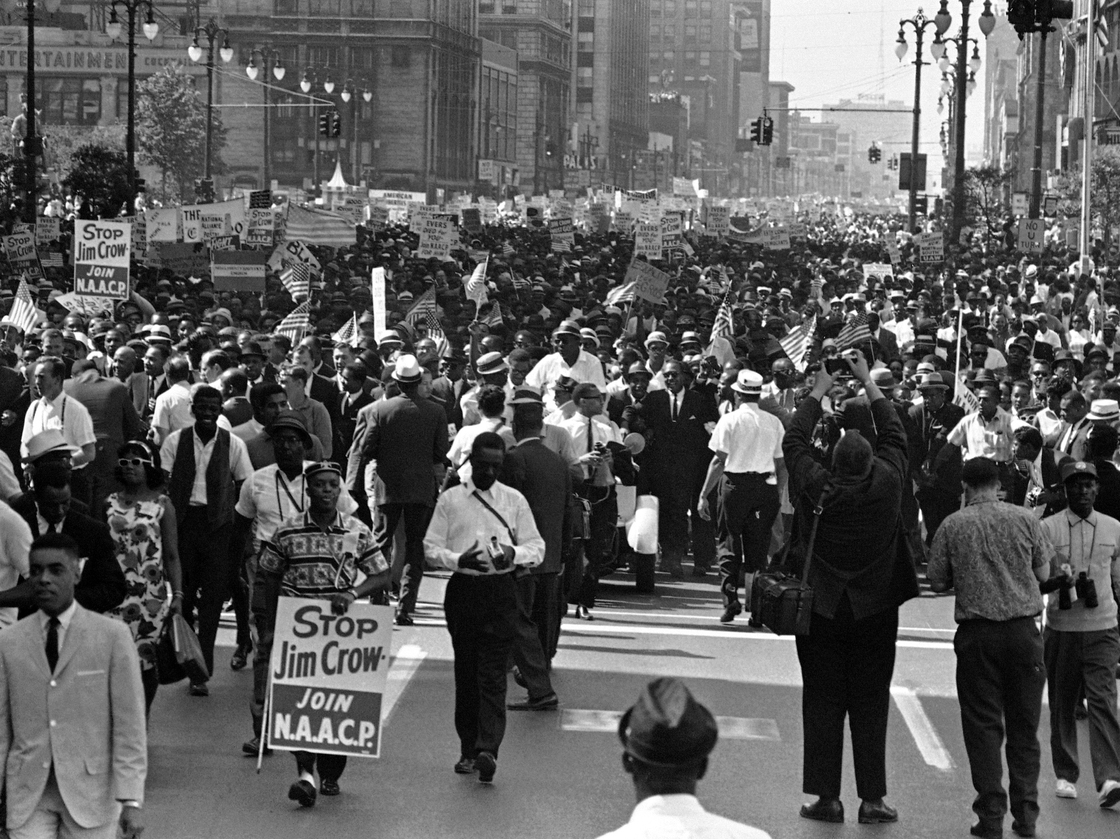
Martin Luther King, Jr. speaks to a crowd in Detroit on June 23, 1963.

"We want all of our rights!" Martin Luther King, Jr. told a throng of people gathered in and around Detroit's Cobo Arena on June 23, 1963. He was speaking at what he called the largest and greatest demonstration for freedom ever held in the United States. "We want them here, and we want them now!" he said.

Fifty years ago this August, King gave the iconic "I Have A Dream" speech at the March on Washington. But the first time King spoke of his dream of equality and brotherhood between the races, was earlier that summer in Detroit.

Parts of King's Detroit speech may sound familiar to those who have heard the address he gave at the March on Washington. But the Detroit speech was tailored especially for a city with a long history of Civil Rights activism.

"I have a dream this afternoon, that one day, right here in Detroit," King said, "Negroes will be able to buy a house or rent a house anywhere that their money will carry them, and they will be able to get a job."

Organizers of "The Walk to Freedom" wanted to speak out against the brutality that Civil Rights activists faced in the South. They also wanted to address the inequities in jobs, housing and education faced by blacks in the North. King's speech dealt with it all.

"I have a dream this afternoon ... that one day little white children and little Negro children will be able to join hands as brothers and sisters," King said.

King gave his Detroit speech just two weeks after NAACP field secretary Medgar Evers was assassinated. His speech also came on the heels of protests in Birmingham, Ala., where police chief Bull Connor ordered police to use fire hoses and dogs to break up demonstrations.

"Before the victory is won, some like Medgar Evers may have to face physical death," King told the Michigan crowd. "But if physical death is the price that some must pay to free their children and white brothers from an eternal psychological death, then nothing can be more redemptive.

Grace Lee Boggs, 98, a longtime Detroit resident and activist who helped to organize the "Walk to Freedom," attended King's speech afterward.

Martin Luther King, Jr., leads thousands of protesters along the streets of Detroit on June 23, 1963.
AP Martin Luther King, Jr., leads thousands of protesters along the streets of Detroit on June 23, 1963. Martin Luther King, Jr., leads thousands of protesters along the streets of Detroit on June 23, 1963.
AP
Boggs said King's address spiked the Civil Rights movement in the city. People there remember it not so much for the speeches, but for the organization and the way it brought the whole state together.

"It really changed conditions in the city," Boggs said.

Gloria Mills was just 14 in June 1963, but she was there the day more than 125,000 people streamed down Woodward Avenue.

"It was just thrilling," Mills recalled, adding that they piped King's voice out of Cobo Arena all around the river area so the people outside could hear. "I can still feel the chills from listening to that man speak because of the timing and then his leadership.

"We just knew we were on the precipice of something very, very important."

Lonnie Bunch, director of the Smithsonian's National Museum of African American History and Culture, said King often tried out themes for his speeches. Not only did he give his Detroit speech in June, but he also gave a similar one in Newark, N.J., in January 1963. Bunch says King knew it was critical to have the right tone. And by the time it came to the March on Washington, King knew exactly the rhythm he wanted and the story he wanted to tell.

"While there's something wonderful about imagining it as if it sprung from the head of Zeus, it really is part of long months of work and study just to get it right," Bunch said.

At the University of Michigan in Ann Arbor, Stephen Ward, a professor of African-American history, said people shouldn't think of King's speech in Detroit as a preview of his words at the March on Washington. Ward, who specializes in the Black Power movement of the 1960s and '70s, says the Detroit and Washington speeches are not the same.

"I think he was giving a speech for each context," Ward said. "In (Washington) D.C., he's speaking to a national audience, in the nation's capital, trying to push the civil rights legislation."

Like many preachers, and Civil Rights activists, Ward says King would use some of the same language and ideas in different places. And he believes the way most people think about the March on Washington — and the speech — is limiting.

"It was his March on Washington speech," Ward said, "which included the 'I Have a Dream' oration and idea which he gave at least in Detroit and probably a few other places, because those are the things he was thinking about and he was communicating and sharing."

The NAACP in Detroit and UAW-Ford sponsored a 50th anniversary celebration of the "Walk to Freedom."

Detroit NACCP President Rev. Wendell Anthony said the march and a series of workshops were about trying to continue King's work against violence, racism, voter suppression and the inequities in employment that continue to plague his city.

"Dr. King was about bringing folk together," Anthony said. "So that fact that we leave him on the mountaintop dreaming is our fault. He wouldn't want to be there. He wants to be back down in the valley working."